ShadowCat: early attack warning with a log nobody can quietly edit
- Problem
- Move network defence from signature matching to learned estimates of whether an attack is under way or about to start, with every forecast provable later.
- My role
- Team lead of a 6-member team that built both ShadowCat and SHIKRA. Here I built the data ingestion into the network-state representation and the cryptographic audit chain.
- Links
- RepoEvery claim, with source
Detection, onset and the world model
Representation
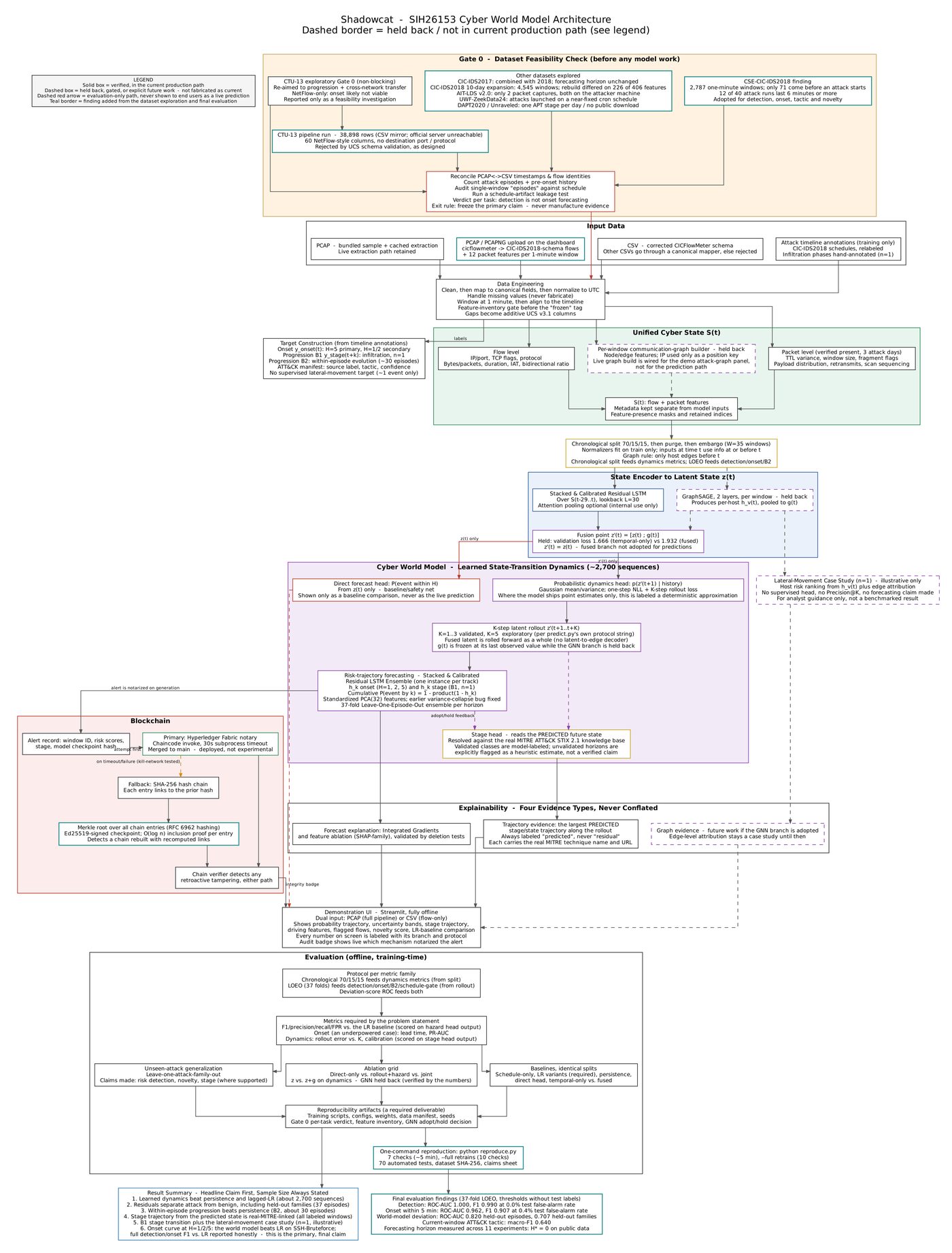
Each minute of traffic becomes a 406-feature "unified cyber state": 388 flow features, 12 packet-level features parsed from raw captures, and 6 presence masks so missing telemetry is marked absent instead of zero-filled. An LSTM world model learns how that state evolves over a 30-minute lookback.
Evaluation protocol
- 37-fold leave-one-episode-out on CSE-CIC-IDS2018, with a 36-window purge around each held-out episode so neighbouring minutes can't leak.
- Scaler, PCA and models refit inside every fold.
- Decision thresholds chosen without any test labels.
- A separate leave-one-day-out stress test, where whole attack families are unseen.
| Task | Model | ROC-AUC | F1 | False-alarm rate |
|---|---|---|---|---|
| Detection | Stacked ensemble | 1.000 | 0.990 | 0.0% |
| Detection | Logistic regression | 1.000 | 0.980 | 0.0% |
| Onset ≤ 5 min | Stacked ensemble | 0.962 | 0.907 | 0.4% |
| Onset ≤ 5 min | Logistic regression | 0.952 | 0.896 | 0.4% |
What did not work, and why
The problem statement asks for forecasts several minutes ahead. Across 11 experiments (capacity sweeps, a mixture-density head, Monte Carlo rollouts, 10 capture days instead of 6, and three other datasets), the reliable forecast horizon stayed at zero. Two measured causes: only 71 of 2,787 windows actually precede an attack, and a Gaussian next-state loss collapses toward the majority class. We reported the horizon with confidence intervals instead of tuning until a number looked good.
A GraphSAGE graph-fusion model had lower test error but worse validation loss, so it was held back: choosing it on test error would have leaked the test set.
Ingestion and a provable audit trail
Ingestion
- Accepts CICFlowMeter flow CSVs or raw PCAP / PCAPNG uploads; other schemas are mapped or rejected, never guessed.
- A packet parser extracts TTL, fragmentation, payload percentiles, retransmissions and a port-scan score from raw captures.
- Everything is bucketed into UTC one-minute windows with explicit presence masks.
Audit chain
Every model, report and forecast is appended to a SHA-256 hash chain signed with Ed25519. A signed Merkle root (RFC 6962 hashing) commits to the whole chain, so anyone can check that one forecast is in the log with an O(log n) inclusion proof, and a chain rebuilt with recomputed links is still detected. Hyperledger Fabric notarisation is optional, with automatic fallback.
Try it: tamper with a forecast log
A simplified version of ShadowCat's audit chain: a registered model, a forecast it made, and the report that cites it. Each entry stores the SHA-256 hash of the one before it. Change the forecast's probability, as someone hiding a missed alert might, and every later entry stops verifying. The real chain also signs each entry with Ed25519 and commits to all of them with a Merkle root.
Quality and reproducibility
- 75 automated tests, including one that blocks known placeholder values from reaching the dashboard.
python reproduce.pyrecomputes every headline number in about 5 minutes on a laptop CPU and checks it against the committed artifacts;--fullretrains.
What I'd do next
- Train the forecasting pipeline on whole-network captures of multi-stage campaigns, which the public datasets we checked do not have.
- Publish per-fold variance alongside the pooled scores on the project page.